What Documents Do You Need for Constructionline Certification?

Matt Watson
20 Aug, 2026







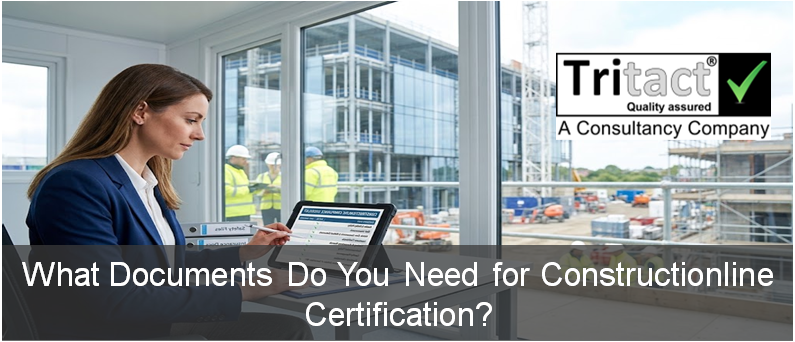
Getting Constructionline Certification can help UK contractors, subcontractors and suppliers demonstrate that they meet important procurement and compliance requirements. It can also make it easier for businesses to be considered for construction projects and tender opportunities.
However, one of the most important parts of the process is preparing the right documents.
Incomplete, outdated or inconsistent information can lead to delays and requests for additional evidence. That is why it is important to understand what paperwork may be required before starting your application.
This guide explains the key documents UK businesses should prepare for Constructionline Certification and how to organise them effectively.
What Is Constructionline Certification?
Constructionline is an industry service and procurement platform for buyers and suppliers in the UK construction industry. Constructionline requires suppliers to present evidence of certain services and requirements depending on the level of their membership and the type of assessment. This may include evidence around health and safety, finance, insurance, quality management, the environment, and the competence of the workforce.
Constructionline requires all applicants to present evidence relevant to their business activity and the level of their membership.
It is generally more convenient to prepare your documents in advance.
1. Health & Safety Policy
One of the key documents that a construction business must have prepared is a current Health and Safety Policy.
A Health and Safety Policy must describe how an organisation manages health and safety of its employees and the procedures that will be implemented to achieve it.
A health and safety policy must outline your company’s responsibilities towards health and safety, as well as the responsibilities of management and employees. It should include details of the processes and systems for managing risks and should also provide details of the current health and safety policy and state where the policy is to be found. Health and safety policies need to be signed by an appropriate senior member of the company. It is also essential that the policy is relevant to your company and not simply a generic policy.
2. Risk Assessments
Risk assessments are a legal requirement for every construction company.
Your assessments should identify the hazards related to your work, measure the risk and explain the control measures in place to mitigate the risk.
These may include assessments of:
- work at height
- manual handling
- electrical work
- excavation and groundworks
- use of machinery
- slips, trips and falls
- hazardous substances
- activities on construction sites
Do not submit meaningless risk assessments.
3. RAMS, Methodologies and Safety Statements
RAMS (Risk Assessments and Method Statements) describe the means by which a particular work activity will be undertaken safely.
Depending on the nature of your work activities, you may require a number of different types of construction work method statements.
A good method statement should set out:
- the work activity
- hazards
- control measures
- equipment and material
- competent personnel
- personal protective equipment
- emergency arrangement
Keeping these in order and up to date will demonstrate that your company has an operational safety plan for your company.
4. Insurance
Construction companies should prepare evidence of insurance covering their activities.
Your specific business activities and needs may mean you require further insurance coverage such as:
- Employers' Liability Insurance
- Public Liability Insurance
- Professional Indemnity Insurance
- Other relevant specialist insurance
Please make sure you have the current versions of all certificates, and that the company name on your insurance documents matches the name on your account.
Having expired certificates or name inconsistencies on your account can create delays.
5. Training and Competency Records
Constructionline assessments sometimes ask for evidence that employees and workers have been trained and have the skills necessary to perform their role.
Examples of relevant records may include:
- CSCS cards
- Health and safety training
- First aid certificates
- Training on working at height
- Manual handling training
- Asbestos awareness training
- Plant and machinery training
- Site-specific training
- Relevant trade qualifications
Ensure that records are filed efficiently so that required evidence can be provided quickly.
6. Environmental Policies and Documents
There is a greater focus on environmental management in UK construction procurement.
Depending on the assessment requirements and membership level, your business may need environmental policies and supporting documents.
These may include:
- Environmental Policy
- Waste Management Policy
- Waste Transfer documentation
- Environmental risk assessments
- Sustainability and related procedures
- Energy management and related procedures
- Evidence of recycling arrangements
Your documents should reflect the environmental management systems and activities of your business.
7. Quality Management Documents
Construction businesses should also consider preparing documents that demonstrate how they manage quality.
These may include:
- Quality Policy
- Quality Management procedures
- Inspection procedures
- Quality control procedures
- Customer complaint procedures
- Corrective action procedures
- Project quality records
If your business has other quality management certifications (e.g. ISO 9001), these may also be used to demonstrate other quality management systems where relevant.
8. Financial Information
Depending on the level of Constructionline membership or assessment, businesses may need to provide financial information.
This shows you can help demonstrate that the company is financially stable and suitable for the work.
Potential evidence may include:
- Company accounts
- Financial statements
- Credit information
- Turnover information
- Other financial evidence required
It is always required that you submit requested information and avoid submitting additional and unnecessary documents.
9. Company and Business Details
Ensure accurate and consistent basic information about your business on all company documentation.
This may include:
- Registered company name
- Trading name
- Company registration details
- Business address
- Contact details
- Services offered
- Types of construction work related to your business
- Company structure
Differences between supporting documentation and your application may elicit questions from the assessment team
10. Policies and Procedures
The business size, activities and workforce will affect the business’s policy and procedures.
Policies may include:
- Equality and diversity
- Data protection
- Modern slavery
- Anti-bribery
- Corporate social responsibility
- Complaints
- Accident and incident reporting
- Emergency procedures
Not every business will be required to provide the same documentation, so focus on the policies that are relevant for your business and assessment requirements.
How to Organise Your Constructionline Documents
Simply having the documents is not enough. They should be easy to find and clearly organised.
A useful structure could include folders for:
01 - Company Information
02 - Health & Safety
03 - Risk Assessments & RAMS
04 - Insurance
05 - Training & Competency
06 - Environmental
07 - Quality Management
08 - Financial Information
09 - Policies & Procedures
Digital copies should have clear file names and review dates.
For example, instead of naming a file policy-final.pdf, use a clearer format such as:
Health-Safety-Policy-2026.pdf
This makes document management much easier.
How to Avoid Delays During Constructionline Certification
Before submitting your application, carry out a final documentation check.
Make sure:
- All policies are current
- Documents have appropriate review dates
- Required signatures are included
- Insurance certificates have not expired
- Training records are current
- Risk assessments reflect your actual activities
- Company details are consistent
- Supporting evidence matches your application
- Documents are easy to locate and read
A final review can identify simple errors before they become a reason for additional questions or delays.
Do Small Construction Companies Need All These Documents?
Not necessarily.
The documents required can vary depending on the size and nature of your business, the work you undertake and the Constructionline membership or assessment level involved.
A small subcontractor may not need the same level of documentation as a larger main contractor.
The important point is to prepare the evidence relevant to your specific application rather than creating unnecessary paperwork.
Ready to Prepare for Constructionline Certification?
Getting your documents ready before applying can make the Constructionline Certification process much more straightforward.
The key is to maintain accurate, current and business-specific evidence covering areas such as health and safety, insurance, workforce competence, environmental management, quality and financial information.
If you are unsure whether your documentation is complete, professional compliance support can help identify gaps before submission and reduce the risk of unnecessary delays.
Tritact® Consulting supports UK businesses with Constructionline preparation and compliance documentation, helping contractors and suppliers organise the evidence they need and approach the Constructionline Certification process with greater confidence.