ISO/IEC 27001 vs Cyber Essentials Which Does Your Business Need

Naeem Ulfat
16 Nov, 2026







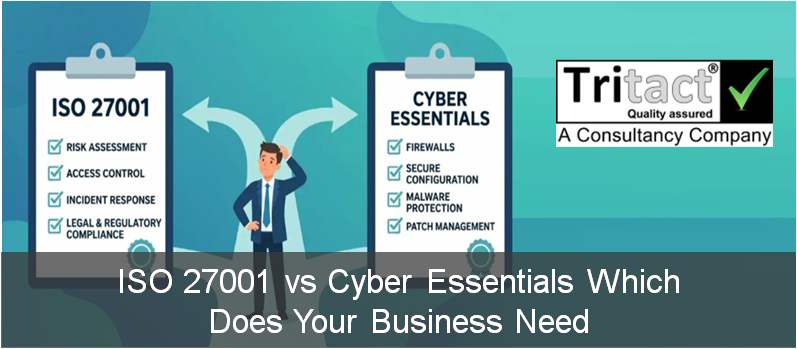
Cyber Essentials or ISO/IEC 27001 Which Certification Does Your Business Need
Customers are often asked to demonstrate Cyber Essentials or ISO/IEC 27001 certification in tenders and security questionnaires. Although both provide assurance about security, they serve different purposes: Cyber Essentials focuses on five baseline technical controls, while ISO/IEC 27001 assesses an organisation’s wider information security management system.
The right choice depends on the requirement, the organisation’s risks and the assurance expected by customers. Cyber Essentials is often a practical first step for smaller organisations, while ISO/IEC 27001 may be more appropriate where customers require a formal, risk-based management system. Some organisations hold both certifications, but the order should be based on contractual and business needs.
How Cyber Essentials and ISO/IEC 27001 Work
Cyber Essentials
Cyber Essentials is a UK Government-backed scheme developed by the National Cyber Security Centre (NCSC) and delivered through IASME and licensed Certification Bodies. It addresses five technical control themes: firewalls, secure configuration, security update management, user access control and malware protection. Cyber Essentials is a verified self-assessment marked by a qualified external assessor. Cyber Essentials Plus covers the same controls but adds independent technical testing by a licensed Certification Body; it is not assessed directly by the NCSC.
Cyber Essentials and Cyber Essentials Plus certificates are valid for 12 months and must be renewed annually. The current Cyber Essentials Requirements for IT Infrastructure are version 3.3, effective from 27 April 2026. Applicants should use the current requirements and question set available through the NCSC or IASME when preparing an assessment.
ISO /IEC 27001
ISO/IEC 27001:2022, together with Amendment 1:2024, is the current international standard for information security management systems. An organisation defines its ISMS scope, assesses information security risks, selects necessary controls and records its decisions in a Statement of Applicability. Annex A contains 93 reference controls, but organisations may select additional controls where required. Certification normally involves Stage 1 and Stage 2 audits by an independent certification body. A typical accredited certification cycle lasts three years and includes surveillance audits, usually annually.
The transition deadline for accredited certificates to move from ISO/IEC 27001:2013 to ISO/IEC 27001:2022 was 31 October 2025. Organisations seeking certification should therefore work to the 2022 edition and its applicable amendment.
Cyber Essentials and ISO/IEC 27001 Side by Side
|
Question |
Cyber Essentials |
ISO/IEC 27001 certification |
|
What it covers |
Five baseline technical controls across in-scope devices, software, networks and cloud services |
A risk-based information security management system covering people, processes, suppliers and technology |
|
How it is assessed |
Verified self-assessment; Cyber Essentials Plus adds independent technical testing |
Stage 1 and Stage 2 certification audits, followed by surveillance audits |
|
Certificate lifecycle |
Valid for 12 months and renewed annually |
Typically a three-year certification cycle with annual surveillance audits |
|
Typical effort |
Depends on scope and readiness; often shorter than ISO IEC 27001 |
Usually requires several months to design, implement and evidence an effective ISMS |
|
Best suited to |
Baseline technical assurance and contracts that specify Cyber Essentials |
Risk-based governance, customer assurance and contracts that specify ISO IEC 27001 |
Is Either Certification a Legal Requirement
Neither certification is generally required by UK law. However, the UK GDPR and Data Protection Act 2018 require organisations to protect personal data through appropriate technical and organisational measures. Certification may support assurance, but it does not remove an organisation’s legal responsibilities.
Contractual and procurement requirements are often the deciding factor. Certain in-scope UK public contracts require Cyber Essentials or Cyber Essentials Plus, or evidence of equivalent controls, where this is relevant and proportionate. Other customers may specify ISO/IEC 27001. Read the tender wording carefully because one certification does not automatically satisfy a requirement for the other.
When Cyber Essentials Is the Right Choice
Consider a 12-person IT support firm bidding for council work where the tender asks for Cyber Essentials. This is an illustration, not a client case. The firm may need to update devices, restrict administrative privileges, enable multi-factor authentication for cloud services and maintain suitable malware protection. Certification can be achieved once the organisation meets the requirements and passes the verified assessment; the timeframe depends on its starting position and the assessor’s availability.
Cyber Essentials may suit organisations that:
- want a practical first step towards improving cyber security;
- need baseline assurance for customers, insurers or tenders; or
- do not yet operate a formal information security risk-management system.
Where a buyer wants independent technical testing of the controls, Cyber Essentials Plus may be the better fit.
When ISO/IEC 27001 Certification Makes More Sense
Consider a 60-person software company that processes customer data and regularly completes detailed security questionnaires. If major customers require ISO/IEC 27001, baseline technical controls alone may not provide the requested assurance. The company may need to demonstrate a structured approach to risk management, supplier security, staff competence and awareness, incident management, access control, internal audit and management review.
These wider governance and management-system requirements are addressed by ISO/IEC 27001 but are not assessed as part of Cyber Essentials.
Holding Both Certifications
For many small and medium-sized organisations, Cyber Essentials can provide a useful technical baseline before they work towards ISO/IEC 27001. However, this is not a mandatory sequence. An organisation should prioritise the certification named by its customers or tenders and should not assume that evidence from one scheme will automatically satisfy the other.
ISO/IEC 27001 certification does not automatically demonstrate conformity with every Cyber Essentials requirement. Similarly, Cyber Essentials does not demonstrate that an organisation operates an ISO/IEC 27001-conforming ISMS. Unless the buyer confirms that an alternative is acceptable, provide the certification specifically named in the contract or tender.
Mistakes That Waste Time
- Choosing on price or speed alone. Select the scheme that meets the relevant customer, tender and risk requirements.
- Defining the scope incorrectly. Omitting cloud services, internet-facing services or home-working devices can invalidate assumptions and delay assessment.
- Treating certification as a one-off exercise. Cyber Essentials requires annual renewal, while ISO/IEC 27001 certification requires continuing operation of the ISMS, surveillance audits and recertification.
- Ignoring unsupported software. In-scope software must be supported and security updates must be applied in accordance with the scheme’s requirements.
Getting Help Choosing
If you are unsure which certification to pursue, review recent tenders, contracts and customer security questionnaires. They will usually indicate the assurance expected by the market. A focused gap analysis can then identify the work required for Cyber Essentials, ISO/IEC 27001 or both.
Tritact® Consulting supports organisations preparing for Cyber Essentials and Cyber Essentials Plus, including scope review, self-assessment support and technical-audit readiness. We also provide ISO/IEC 27001 implementation and internal-audit support before an independent certification audit. Certification decisions remain with the relevant independent Certification Body. Contact us to discuss your requirements and request a quotation.